
Smart garage inventory with AI: a complete guide

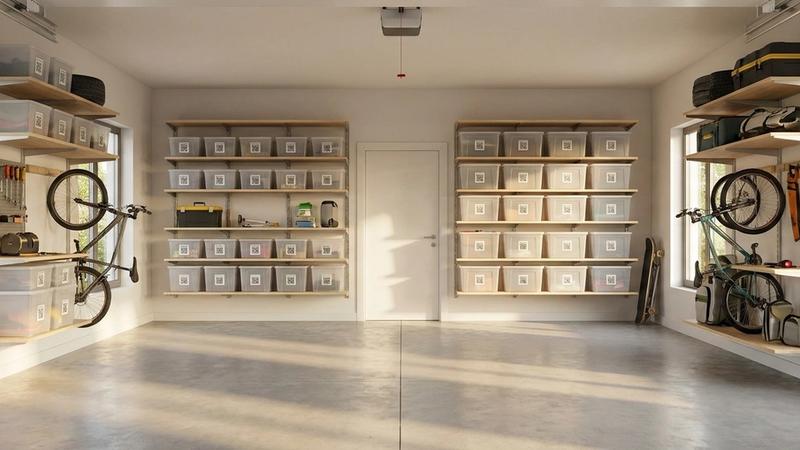
Smart garage inventory with AI: a complete guide
Garages are where good intentions go to die. The bike helmets, the half-empty paint cans, the M6 bolts from a 2019 IKEA shelf, the snow chains you used twice — they all end up in the same blue plastic bin, on the same shelf you can’t quite reach. And every time you need something, you open four bins before finding it.
The usual fixes — paper labels, a clipboard inventory, a spreadsheet your spouse refuses to update — don’t last past week three. They’re too much work for too little reward.
A smart garage inventory built on AI image recognition and QR-coded bins is a different category. You take one photo per bin, stick a sticker on the lid, and the inventory builds itself. Here’s how it works and why it actually sticks.
The garage problem in one paragraph
Most of your garage stuff is small, opaque, and visually similar from the outside. Twenty identical plastic bins on a shelf give you zero information. The cost isn’t dramatic — it’s the slow drip of five lost minutes here, a duplicate purchase there, a project abandoned because you couldn’t find the right drill bit. Compound that over a year and it adds up to real time and real money.
Why spreadsheets and label-makers fail in a garage
Spreadsheets fail because the garage is the worst possible data-entry environment. Your hands are dirty, the light is bad, you're holding a box of screws in one arm, and the laptop is inside the house. Any system that requires you to sit down, open a tab, and type a row will be abandoned by the second weekend.
Label-makers fail for the opposite reason: they're too rigid. A label says "Camping gear" — but the bin actually holds a camping stove, two headlamps, a tarp, three tent pegs, and a bottle of citronella you forgot about. By the time the contents drift, the label is a lie. And relabeling means peeling, reprinting, and re-sticking, which nobody does.
Both approaches share the same flaw: they ask you to describe your stuff in words, in advance, and keep that description in sync forever. Humans are bad at this. Cameras and AI are good at it.
How AI image recognition changes the equation
Modern vision models can look at a single photo of an open bin and produce a structured list of what's inside — "cordless drill, two battery packs, charger, set of drill bits, tape measure, safety glasses" — in a few seconds. You don't write anything. You don't categorize anything. You point, shoot, and the inventory writes itself.
That sounds like a small change, but it removes the entire data-entry tax that killed every previous system. The marginal cost of cataloging a new bin drops to about the time it takes to lift the lid and tap a button. At that price, you actually do it.
The AI isn't perfect — it will occasionally call a socket wrench a ratchet, or miss the small parts at the bottom — but you can correct an item in two taps, and the corrections only matter for things you'll actually search for later.
Why QR-coded bins are the other half of the system
A photo-based inventory is only useful if you can connect the digital record back to the physical bin in your garage. That's what QR labels solve. Each bin gets a unique sticker. Scan it with your phone and you instantly see what's in it, when you last updated it, and any notes you've added — without opening the bin.
This matters for two reasons. First, it works in reverse: when you're standing in the garage wondering "where did I put the extension cord," you search the app, and it tells you "Bin 14, second shelf from the top." Second, it makes updates almost free. Add a new item to a bin? Scan, snap, done. Move a bin to the basement? Scan, change location, done.
The combination — AI for the contents, QR for the identity — is what makes the system durable. Neither half works well alone.
A realistic setup for a normal garage
You don't need to inventory everything in one weekend. The realistic path looks like this:
- Start with the bins you open most often: tools, hardware, seasonal sports gear, car maintenance.
- Stick a QR label on each, take one photo of the open contents, and let the AI populate the items.
- Add the next batch — holiday decorations, camping, gardening — over the following weekends.
- Leave the genuinely archival stuff (old tax returns, baby clothes for the attic) for last, or never.
Most people end up with 20–40 labeled bins covering 80% of what they actually search for. That's enough to make the garage feel solved.
What this looks like day-to-day
Once the system exists, the behavior changes in small ways. You stop buying duplicate AA batteries because you can check the bin from the supermarket aisle. You finish projects because you find the right bit on the first try. When you lend out a tool, you note it in the bin's record and actually remember who has it. When you move house, the inventory comes with you — every bin already labeled, already cataloged, ready to load into the truck.
It's not life-changing. It's just the quiet removal of a low-grade friction you'd stopped noticing.
Where Asamano fits
Asamano is built around exactly this loop: QR-labeled bins, AI image recognition for contents, voice notes when typing is awkward, and a search that works from your phone in the garage. You order a pack of pre-printed QR labels, stick them on your bins, and start scanning. The free plan covers a small garage; the paid plans scale up if you're cataloging a workshop, a storage unit, or a whole house.
If your garage has reached the "open four bins to find one thing" stage, that's the signal. Start with five bins this weekend and see how it feels by next Saturday.
Read in other languages
- noSmart garasjeinventar med AI: en komplett guide
- esInventario inteligente del garaje con IA: una guía completa
- svInventera ditt garage med hjälp av AI: en komplett guide
- svSmart garageinventering med AI: en komplett guide
- ptInventário inteligente de garagem com IA: um guia completo
- esInventario inteligente de garaje con IA: una guía completa