
The real cost of “where is it?” in a small business

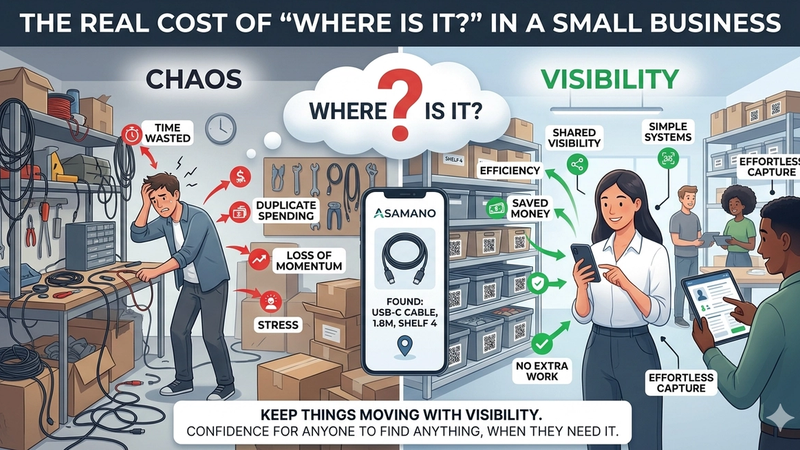
On Monday morning, Jonas needed a specific cable for a client installation.
He was sure the team had one.
But no one knew where it was.
So he asked around.
“Maybe in storage?”
“Check the back room.”
“I think we used the last one…”
After 20 minutes of searching, he gave up and ordered a new one.
It arrived the next day.
Later that week, someone found three of them in a box.
This happens more than you think
In small businesses, this pattern shows up everywhere:
- Tools
- Equipment
- Spare parts
- Documents
And every time it happens, it costs something:
- Time
- Money
- Momentum
But more than that—it creates friction.
The hidden dependency
Many small businesses rely on one person who “knows where things are.”
When that person is unavailable, everything slows down.
This isn’t a people problem.
It’s a system problem.
Visibility is the missing layer
Most businesses already have storage.
Many even have processes.
What they don’t have is shared visibility.
A simple way for anyone to answer:
“What do we have—and where is it?”
Without asking.
Without searching.
What changes when visibility improves
When Jonas introduced a simple system to track items:
- The team stopped interrupting each other
- Fewer duplicate purchases were made
- New employees got up to speed faster
But the biggest change?
Less stress.
Why simplicity matters
In a small business, no one has time for complex systems.
If it takes effort, it won’t be used.
That’s why the best solutions are:
- Fast
- Simple
- Easy to maintain
Tools like Asamano are designed with this in mind—making it effortless to capture and find information without adding extra work.
The real benefit
It’s not just efficiency.
It’s confidence.
Knowing that anyone on your team can find what they need, when they need it.
Without friction.
Without guesswork.
That’s what keeps things moving.