
What highly organized people (and teams) do differently

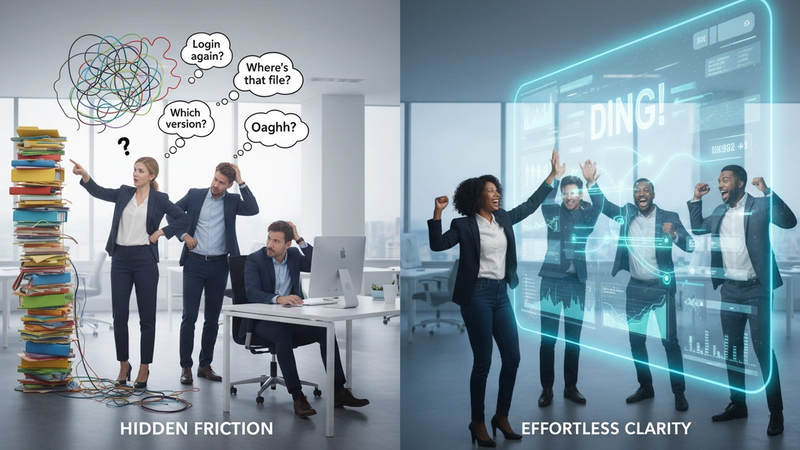
Most people think organized people are just naturally better at keeping track of things.
But that’s usually not true.
They don’t remember more.
They don’t work harder.
And they definitely don’t spend their weekends updating spreadsheets.
What they do differently is simple:
They build systems that make remembering unnecessary.
The hidden cost of disorganization
Markus runs a small creative agency.
From the outside, everything looked smooth. Projects were delivered. Clients were happy. The team was talented.
But internally, there was constant friction.
Small questions kept interrupting the day:
“Where’s the latest version of the file?”
“Do we still have that camera lens?”
“Who has access to the client account?”
“Where did we put the cables from last event?”
None of these problems were major on their own.
But together, they created a constant mental drain.
At home, Markus noticed the same pattern.
Even though his garage and storage spaces looked tidy, he still spent too much time searching for things:
- Chargers
- Tools
- Spare batteries
- Sports equipment
- Travel accessories
- Important documents
The issue wasn’t clutter.
It was friction.
What organized people actually do differently
Highly organized people don’t rely on memory.
They rely on systems that reduce effort.
Instead of trying to remember where everything is, they make information easy to access.
They:
- Create visibility
- Reduce unnecessary steps
- Make retrieval fast
- Remove dependency on one person knowing everything
Their goal isn’t perfect organization.
It’s making everyday life easier.
The mindset shift
Markus introduced one simple principle to his team:
“If someone has to ask where something is, the system isn’t working.”
That changed how they approached everything.
Instead of focusing on control, they focused on visibility.
Could people quickly find what they needed without asking someone else?
Could information be accessed instantly?
Could equipment, files, and supplies be located in seconds?
That became the new standard.
What changed
Over time, the effect was noticeable.
At work:
- Fewer interruptions
- Less time wasted searching
- Smoother collaboration
- Faster project execution
At home, the same thing happened.
Markus stopped buying duplicates because he could quickly check what he already had.
Projects became easier to finish because tools and materials were easy to find.
Daily life simply felt calmer.
Not because everything was perfect.
But because everything was easier.
Why this works
The best organizational systems don’t demand attention.
They remove the need to think about organization altogether.
That’s why complicated systems usually fail.
If maintaining the system feels like work, people stop using it.
The most effective systems are lightweight, fast, and almost invisible.
Making organization effortless
This is where tools like Asamano help.
Instead of manually documenting everything, you can:
- Capture items quickly with photos
- Label storage with QR codes
- Search and retrieve items instantly
- Keep track of where things are with minimal effort
The system does the remembering for you.
The result
You don’t necessarily feel “more organized.”
You simply feel:
- Less stressed
- Less interrupted
- More clear-headed
- More in control of your space and time
And that changes more than people expect.
Read in other languages